There’s a strange new normal in modern parenting: sharenting — the habit of posting kids online — has become so routine that our children now have digital lives long before they understand what “online” even means. Their first smile, their first bath, their first meltdown — captured, edited, and shared in seconds. Not because parents are careless, but because the world has quietly convinced us that documenting childhood is part of being a “good” parent.
But lately I’ve been wondering: what if we’re sharing far more than we realize — and far more than our children would ever choose?
Why Posting Kids Online Feels So Normal (and Why It Matters Now)
When we were growing up, our parents took a handful of photos a year — birthdays, holidays, maybe the first day of school. Film was expensive. Cameras were precious. Childhood lived mostly in memory, not in megapixels.
Today, it’s different. Researchers estimate that by the time a child turns five, parents have posted around 1,000 photos of them online. Creating a Facebook or Instagram account for a baby feels harmless. Posting a cute moment feels normal. But when those moments become daily uploads, reels, or even monetized content… something shifts. Childhood becomes searchable. Traceable. Permanent.
And I can’t help thinking about how it felt when my own parents made us perform for relatives — sing, dance, recite something. I hated it. I felt like a little monkey in a market, expected to “dance when the music plays.” That was just in front of a living room of adults. Today’s children are performing for entire audiences online.
This isn’t about shaming parents. It’s about pausing to ask: What does it mean for a child to grow up with an audience they never asked for?
The Good Intentions Behind Sharing Our Children Online
Whether you post often or hardly at all, this isn’t about blame. It’s about awareness in a world that changed faster than we did.
Most parents don’t post with harmful intentions. They share because:
- they’re proud
- they want to update family and friends
- it feels normal — everyone else does it
- it’s fun to document memories
- social media rewards us with likes, comments, and connection
But good intentions don’t erase the consequences. And sometimes, we don’t realize how much we’re actually sharing.
What We’re Really Revealing When We Share Our Kids
A single photo can reveal:
- where you live
- which school your child attends
- your daily routines
- the layout of your home
- your child’s full name
- their hobbies, fears, and vulnerabilities
Parents often don’t notice how quickly these details add up. A few posts a week can turn into thousands of images by the time a child starts school. In fact, over 80% of children have some kind of online presence by age two — often created before they can even walk.
But the issue isn’t only what we share — it’s how sharing changes the way children experience their own lives.
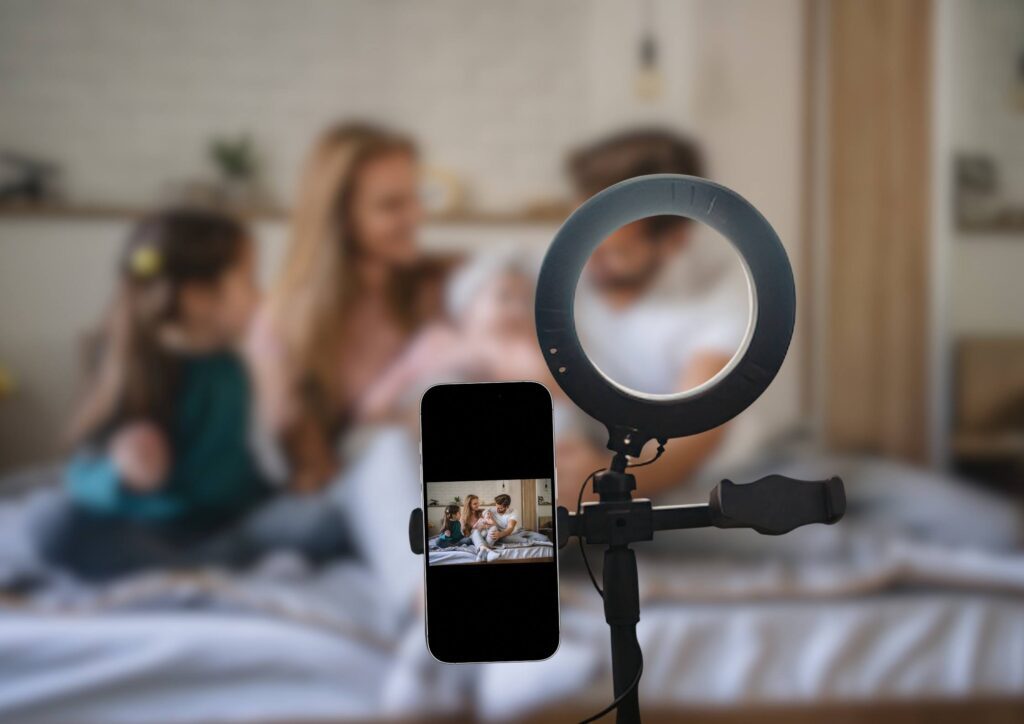
And then there’s the performative side of it. Some families seem to live in a permanent movie set — cameras always on, lights switched on to capture a “cute sleeping moment,” kids asked to repeat something funny “for the video.” It makes me wonder: are these children living their lives, or performing them?
When Childhood Becomes a Performance
Children learn fast. If a camera appears every time they do something adorable, they start to associate attention with performance. They learn that being entertaining brings approval. They learn to repeat behaviors because it pleases adults.
And unlike my childhood performances in front of relatives, these moments don’t disappear when the guests go home. They stay online forever.
The Hidden Cost of Monetizing Childhood
Family vlogs, reels, and YouTube channels have turned childhood into content. Some parents earn money from their children’s lives — sometimes significant amounts. Top child influencers can earn hundreds of thousands of dollars a year, yet in most places, there are no laws protecting their income or working conditions.
But here’s the uncomfortable truth:
- children in online content have no labor protections
- they can’t consent
- they can’t understand the long-term consequences
- they may feel pressure to perform
- they inherit a digital identity they didn’t choose
If we wouldn’t put our child in a beauty pageant or acting job without careful thought, how is this different?
The Quiet Dangers We Don’t See Online
Digital kidnapping Strangers steal photos of children and pretend they’re their own. It happens more often than people think.
Online predators Even innocent photos can reveal enough information for someone with bad intentions to figure out where a child lives or goes to school.
AI facial recognition Children’s faces can be tracked across platforms, added to datasets, and linked to personal information — often with startling accuracy.
Permanent digital footprints Kids grow up with an online identity created by someone else — one they may not like or agree with.
Why Children Can’t Truly Consent to Being Posted
Children can’t meaningfully consent to being posted online. They don’t understand what “public” means. They don’t understand permanence. They don’t understand audiences.
And many teenagers today say they feel embarrassed, exposed, or resentful about what their parents posted when they were younger. Surveys show that more than half of teens wish their parents had shared less about them online.
It’s worth asking ourselves: Would we be happy if our children posted our vulnerable moments online?
When Admiration Turns Into Expectation: The Modelling Question
People have told me my son is “good-looking” and asked why I don’t take him to modeling agencies. But he can’t even talk yet — how can he consent to something like that?
We’ve seen so many child actors struggle later in life. They didn’t choose fame; it was chosen for them. And while social media fame feels softer, more casual, more “homegrown,” the emotional cost can be just as real.
I once watched a German short film about this topic, and it stayed with me. It showed how easily a child’s life can become content, and how quickly the line between parenting and performance can blur.
It made me ask myself: Is it worth the risk?
A More Mindful Way to Share (Without Oversharing)
I’m not saying parents should never post anything. But maybe we can be more intentional:
- share privately with close family
- avoid posting intimate or vulnerable moments
- don’t film everything — let kids exist without an audience
- ask yourself: “Will my child appreciate this being online in 10 years?”
- remember that children deserve a childhood that isn’t content
A Final Thought on Protecting Their Story
This isn’t about shaming or guilt. It’s about awareness — about noticing how quickly the world has changed and how easily childhood can slip into content without us meaning to.
Maybe the real question isn’t “Should I post this?” but “Whose story am I telling?”
Our children will grow into their own voices soon enough. They’ll choose what to share, what to protect, what to keep sacred.
Until then, maybe the most loving thing we can do is guard the parts of their childhood that can’t be repeated, reposted, or recreated.
The parts meant to be lived, not shared.
If you’re navigating the messy, beautiful chaos of early motherhood, you might find comfort in my story about surviving those early months on broken sleep.